
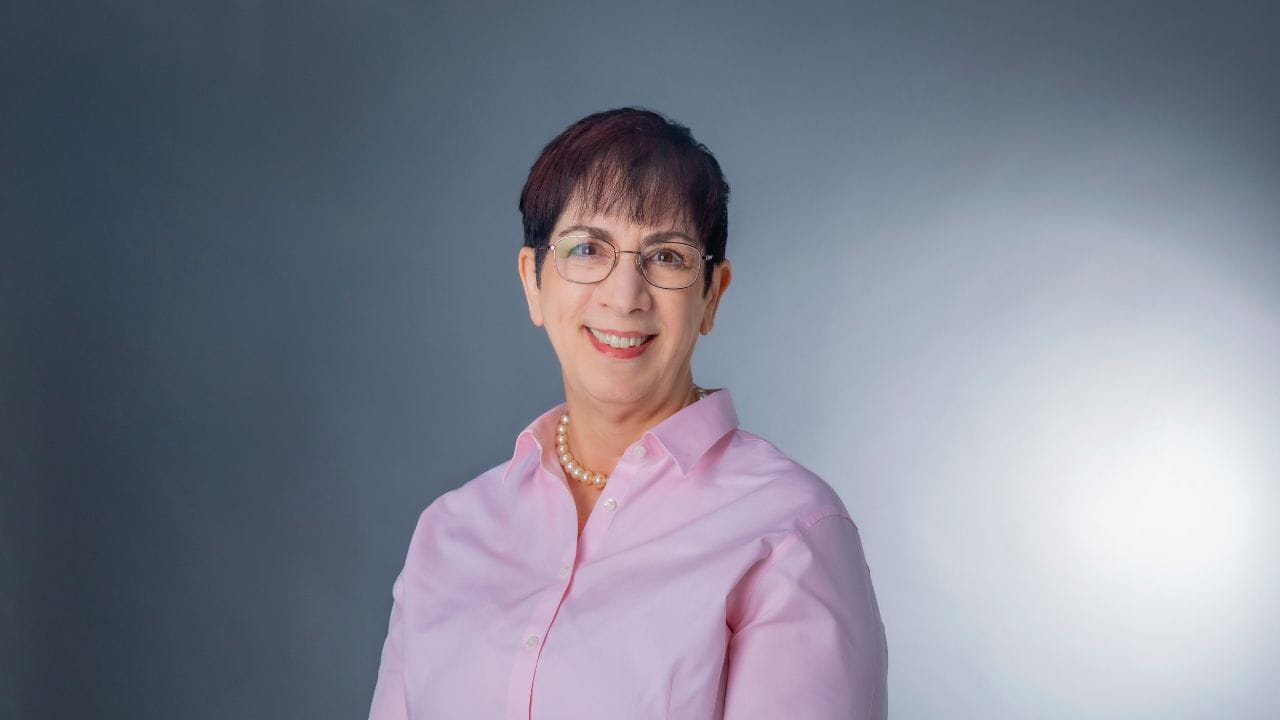
Diana LaRocco’s path to a career in higher education did not begin with a love of school. Instead, it began with an early understanding that everyone experiences the world differently — and that those differences can be immeasurable sources of learning, connection, and service.
Some of her earliest lessons came while walking hand in hand with her grandmother, who lived with a significant visual impairment. “Helping my grandmother was how I learned to cross the street and count change,” Dr. LaRocco recalls. In those moments, learning flowed across generations and abilities, shaped by patience, trust, and mutual awareness. What stayed with her was not just the practical skills she gained, but the realization that knowledge is not one-size-fits-all — and that perspective matters.
Today, as associate provost for learning and teaching at Goodwin University, Dr. LaRocco brings that inclusive, human-centered perspective to instructional design. Her work shapes not only how students learn, but how faculty approach teaching — ensuring that education is accessible, responsive, and grounded in the understanding that everyone brings unique value to the learning experience.
Adapting to early education
As a first-generation college student, Diana LaRocco’s early experiences with education were shaped by transition, adaptation, and resilience.
Education was not deeply embedded in her family’s culture. Her grandfather immigrated to the United States from Naples, Italy; her mother did not complete high school, and her father earned his diploma through a trade school. While learning was valued, navigating formal educational systems often felt unfamiliar and challenging.
Kindergarten was the first challenge. Diana remembers feeling misunderstood and, at times, labeled as misbehaving. “I remember getting a call home from my teacher for not answering when he called my name,” she recalls. “But I didn’t even know he was talking to me. Everyone at home called me Diane.”
In third grade, she transferred to a Catholic school — an experience that introduced a new kind of culture shock. “It was so different from what I’d been experiencing at public school, and I felt unprepared,” she says. “Teachers would only accept assignments completed in cursive, and I had never learned. I had to teach myself.”
When Diana returned to public school for high school, the adjustment was jarring once again, requiring her to relearn expectations, norms, and unspoken rules — often without guidance.
Beyond the classroom, Diana was navigating profound personal challenges. When she was just seven years old, her mother was diagnosed with an aggressive form of breast cancer and underwent a radical mastectomy. As her mother’s health continued declining, it became difficult to fully engage in school.
College was not always part of Diana’s plan — but two educators changed that trajectory. A school counselor encouraged her to apply, and an English teacher provided hands-on support when Diana felt overwhelmed by the application process.
“My first-year English teacher saw me sitting in the cafeteria and knew something was wrong,” she recalls. “She came and sat with me and helped guide me through the process of writing my essays.”
That willingness to go the extra mile made a lasting impact. Diana was accepted to Central Connecticut State University, opening the door to higher education — though not without new challenges.
“If you reach out, there are always people who will help.”
Diana almost didn’t begin her first semester at Central. As her mother’s health worsened, the idea of leaving home felt overwhelming. Still, her family encouraged her to continue pursuing her education.
“I remember having no one to take me on the first day,” she says. “So, my cousin dropped me off.”
The transition to college life was draining. Despite being an engaged student involved in Student Government, Diana struggled academically and found herself failing courses. At one point, she went to the registrar’s office intending to drop out.
Instead, she encountered the dean of students — an interaction that changed everything. The dean helped her reframe her academic path and offered guidance rather than judgment.
Support continued to surface in meaningful ways. A teaching assistant took the time to show her how to study effectively from a textbook, and faculty mentors helped her reconsider her double major in Sociology and Psychology, ultimately encouraging her to focus on Psychology.
These moments reinforced a powerful lesson: inclusive, caring faculty can fundamentally alter a student’s educational experience. “If you reach out,” Diana says, “there are always people who will help.”
Breaking barriers to learning
That spirit of support followed Diana into graduate school, where she pursued a master’s degree in Special Education and earned a research internship. During one pivotal moment, a faculty mentor asked her a question that would reshape her self-perception: “Do you know how smart you are?”
She didn’t — but hearing that affirmation sparked a shift. It gave her the confidence to seek out resources, develop strategies, and fully access the support systems available to her. That guidance carried forward as Diana went on to earn her doctorate and transition into higher education as an educator herself.
As a professor at University of Hartford, Diana mentored future teachers and collaborated across disciplines, including working with the accessibility services department. She also helped train Hartford Public Schools educators through grant-funded initiatives, expanding her impact beyond the University.
It was during this period that Diana engaged with Center for Applied Special Technology (CAST), deepening her engagement with the Universal Design for Learning (UDL) framework. UDL provided a language — and a structure — for what she had experienced all along: that learning environments should be designed to meet learners where they are, not require students to adapt to rigid systems.
Enhancing educational accessibility
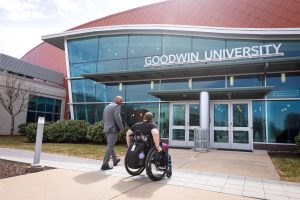
In 2015, Diana was contacted by a former student and colleague, Danielle Wilken, Ed.D, who was serving as Provost at Goodwin at the time and is now President of University of Bridgeport. Their conversation centered on how Universal Design for Learning could be implemented to better serve diverse student populations at Goodwin University. The alignment was immediate.
Diana joined the Goodwin faculty in January 2016. Since then, her work has shaped the institution’s instructional approach from the ground up. Today, as associate provost for Learning and Teaching at Goodwin University, she continues to champion accessibility, equity, and innovation in teaching and learning.
Over the past decade, Diana’s leadership has helped establish the Goodwin University UDL Institute as an international leader in accessible instructional design. The Institute now trains educators across the globe through online courses and provides free resources — including webinars, podcasts, and digitally accessible UDL teaching tips — to support inclusive teaching practices.
Teaching with inclusion and intent
For Diana LaRocco, the future of education is rooted in empathy, flexibility, and intentional design. Her journey — from a child navigating inconsistent systems to a leader reshaping how learning happens — reflects the transformative power of inclusive education.
By embedding Universal Design for Learning into faculty development and instructional design, Diana is helping ensure that students at Goodwin — and educators worldwide — experience learning environments where differences are not barriers, but strengths.
At Goodwin, we start with you — and we’re here to help every step of the way. Learn how Goodwin can support your success in the classroom and beyond!
Bri Gagné is a content developer at Goodwin University, bringing backgrounds in literary studies, creative storytelling, Universal Design for Learning (UDL), and social justice. They earned their bachelor’s degree in English Literature, Film Studies, and Gender Studies from University of Connecticut and a master’s in Elementary Education from Eastern Connecticut State University.
After teaching English abroad and locally, Bri transitioned to a full-time writing career, contributing to the University’s educational narratives and brand-building efforts. They are currently earning their Master of Fine Arts in Popular Fiction Writing and Publishing at Emerson College.