
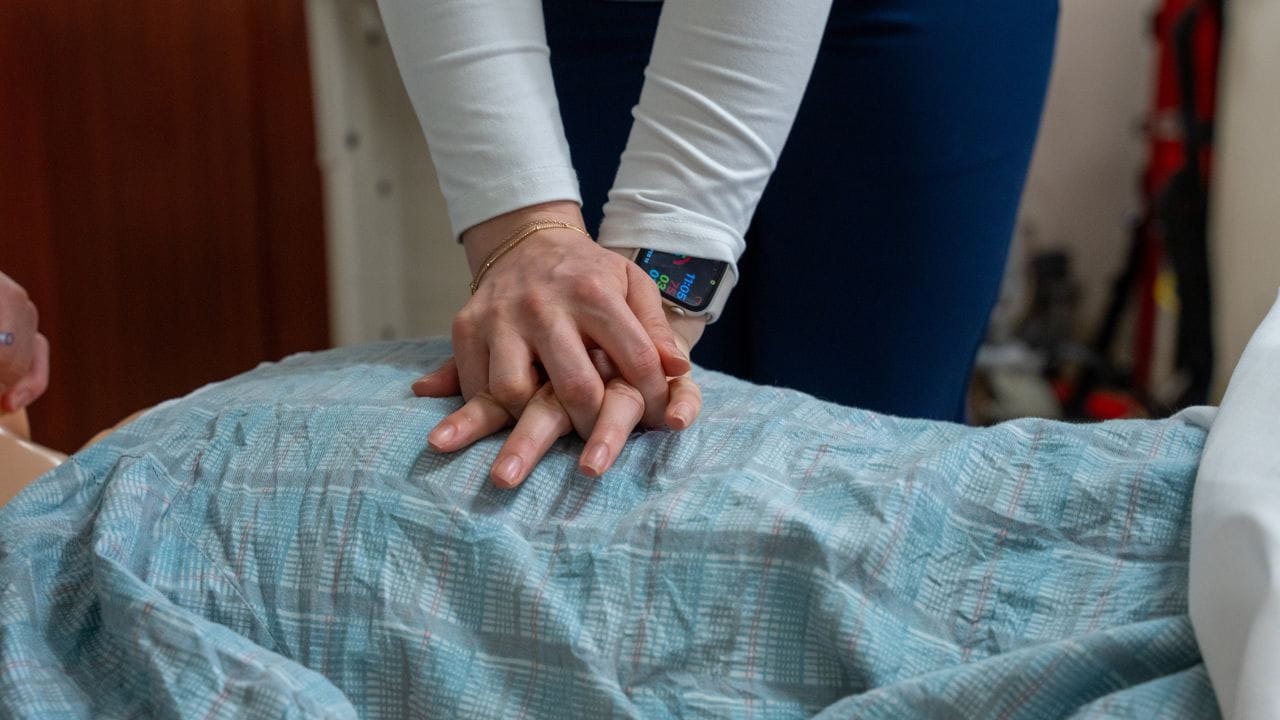
Healthcare continues to be one of the fastest-growing industries in Connecticut and across the nation. According to the Connecticut Department of Labor, the healthcare sector now employs one in eight workers statewide, underscoring both its scale and its sustained demand for skilled professionals.
Among the many roles driving this growth are respiratory therapists — healthcare professionals who life-saving care to patients experiencing acute or chronic breathing or cardiopulmonary conditions. Nationally, demand for respiratory therapists is expected to grow faster than the average for all occupations, according to the U.S. Bureau of Labor Statistics. The Bureau also reports a median annual salary exceeding $80,000, positioning respiratory care as a stable, rewarding entry point into the healthcare field for students seeking long-term career growth and economic security.
At Goodwin University, the Respiratory Care associate degree program is designed to meet this growing workforce need by emphasizing hands-on learning, career-relevant training, and strong industry partnerships. These elements reflect Goodwin’s broader mission of connecting education with community and commerce.
That mission is at the heart of Goodwin’s collaboration with Hartford HealthCare and its Center for Education, Simulation, and Innovation (CESI) — a partnership that gives Respiratory Care students access to advanced, high-tech clinical training environments that prepare them to launch meaningful careers providing care where it’s needed the most.
Exploring one of the nation’s premier simulation centers
Hartford HealthCare is one of Connecticut’s leading healthcare providers, serving patients across the state through an expansive network of hospitals, outpatient centers, and specialty practices. Located on the Hartford Hospital campus, CESI serves as the system’s hub for advanced clinical education, simulation, and innovation.
Spanning more than 50,000 square feet, CESI is nationally and globally recognized as one of the largest and most technologically advanced healthcare simulation centers in the United States. Its mission is to harness emerging medical technologies to reduce risk, improve system performance, and elevate patient safety and outcomes — while also reimagining how healthcare professionals are trained.
To support that mission, CESI houses state-of-the-art bioskills and simulation labs, flexible classroom and presentation spaces, and a wide array of cutting-edge medical equipment. The center is intentionally designed to mirror real clinical environments, allowing learners to practice procedures, decision-making, and teamwork in settings that closely resemble the realities of modern healthcare. For Goodwin’s Respiratory Care students, this environment provides an invaluable extension of their on-campus training.
The collaboration also reflects a shared commitment to strengthening Connecticut’s healthcare workforce. “I think with Hartford HealthCare and Goodwin, we both have the same goal,” says Ashley Kovalik, director of clinical education for Respiratory Care. “There is a significant shortage of respiratory therapists in the state of Connecticut. Our goal is not only to produce respiratory therapy graduates, but very strong graduates to work at places like Hartford Hospital. We want to help alleviate that shortage, but we also want to produce the best graduates possible.”
Immersive simulations — real-world scenarios
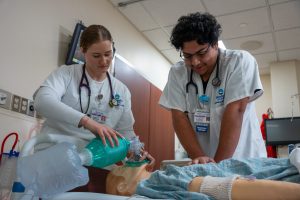
One of CESI’s most advanced and impactful features is its use of high-fidelity patient simulators, often referred to as manikins, which were a primary focus during the Respiratory Care program’s visit. Unlike traditional manikins, these high-fidelity simulators can respond dynamically to student actions — accurately mimicking patient reactions, complications, and physiological changes in real time.
This level of realism makes simulation an especially powerful instructional tool for respiratory care education, where precision, adaptability, and rapid clinical judgment are essential. Program Director Michael Murphy emphasizes the importance of early and ongoing simulation-based learning. “We use simulation continuously in our classroom, almost from the first semester,” Murphy explains. “Before our students ever leave the classroom to go to clinical, we make sure that they’re checked off on all their skills through the use of simulation.”
Beyond refining technical skills, practicing procedures such as CPR and ventilation offer students a critical professional advantage: exposure. Through simulated high-stress, unpredictable scenarios, Respiratory Care students gain experience navigating the pressures of real clinical environments before entering the workforce. In addition, they build familiarity with advanced medical technologies and workflows used in leading healthcare systems.
For many students, this experience also provides early exposure to a future employer. Hartford HealthCare is the largest employer of Goodwin Respiratory Care graduates, with many alumni going on to work within its hospitals and facilities throughout the state — making the partnership a meaningful investment in both student success and the future of healthcare in Connecticut.
A partnership with purpose
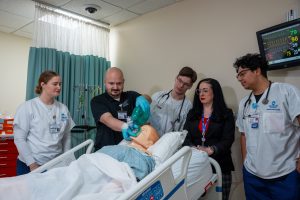
Through its collaboration with Hartford HealthCare’s Center for Education, Simulation, and Innovation, Goodwin University’s Respiratory Care program is redefining what hands-on healthcare education can look like at the associate degree level. By immersing students in realistic, high-stakes clinical scenarios using advanced simulation technology, the program ensures graduates are not only technically prepared but confident, adaptable, and workforce-ready.
As Connecticut continues to face a growing demand for respiratory therapists, partnerships like this one play a vital role in strengthening the healthcare pipeline — benefiting students, employers, and the communities they serve. For Goodwin Respiratory Care students, learning inside one of the nation’s premier simulation centers is more than an educational opportunity; it is a meaningful step toward a career built on skill, compassion, and real-world experience.
Ready to kickstart a rewarding career in respiratory care? You’re in the right place. With flexible hands-on programming, accessible instruction, and community partnerships throughout the state, Goodwin University will help you secure a fulfilling future in an in-demand field. Let’s get started — learn more about our Respiratory Care program today!

Bri Gagné is a content developer at Goodwin University, bringing backgrounds in literary studies, creative storytelling, Universal Design for Learning (UDL), and social justice. They earned their bachelor’s degree in English Literature, Film Studies, and Gender Studies from University of Connecticut and a master’s in Elementary Education from Eastern Connecticut State University.
After teaching English abroad and locally, Bri transitioned to a full-time writing career, contributing to the University’s educational narratives and brand-building efforts. They are currently earning their Master of Fine Arts in Popular Fiction Writing and Publishing at Emerson College.