
Healthcare is the fastest-growing industry in the United States, with roughly 1.9 million job openings expected each year. And it’s no wonder why. Between technological advancements, research breakthroughs, and a record-breaking number of aging adults, the demand for patient care is higher than ever. Healthcare needs skilled, compassionate professionals — and it needs them fast.
If you are considering a career in healthcare, now is the time to get started. Employers across the U.S. are seeking nurses, physicians, medical assistants, dental professionals, and other types of patient care specialists to deliver top-quality care.
So, where do you begin? Healthcare careers vary in their requirements. Depending on your professional goals, you may need several years in medical school. Or, you may opt for faster entry into the field through a career-focused healthcare college.
Let’s explore your options and find out how to choose the best healthcare college or university for you.
What is a healthcare college?
A healthcare college is an academic institution that specializes in the health sciences and prepares students for a range of health professions post-graduation.
The programs offered at a healthcare college or university are highly career-oriented, meaning they hone in on the skills and subjects that are most essential for the industry. In addition to science and technical courses, healthcare college students also gain hands-on training through clinical experiences and internships.
Associate, bachelor’s, and graduate degrees may be offered at a healthcare college or university, as well as postsecondary certificate programs.
Types of healthcare college programs available
Every healthcare college or university will offer a range of focused programs, touching various corners of health and medicine. At Goodwin University in Connecticut, you can find the following career-oriented training programs.
Dental Hygiene (associate degree)
The Dental Hygiene program prepares students for careers as successful hygienists, providing regular dental cleanings, screenings, and education around oral care. Over the course of two years, students complete both in-class and in-clinic learning, with opportunities to work with real patients in the community.
Health Science (associate or bachelor’s degree)
For those who have a passion for health and medicine but are unsure what exactly they want to do, Health Science is a great major to consider. Health Science programs offer a versatile education that covers the fundamental sciences, medical terminology, medical law and ethics, health and wellness, healthcare administration, epidemiology, and more.
Medical Assisting (certificate or associate degree)
Medical assistants are essential professionals who help keep the healthcare system (and teams) running smoothly. Responsible for both administrative and clinical tasks, medical assistants can work in both inpatient and outpatient settings, supporting doctors and nurses. The Medical Assistant program at Goodwin is a fast-track pathway into healthcare, taking just 12 to 16 months to complete.
Medical Billing and Coding (certificate)
For healthcare-inspired professionals who wish to work behind-the-scenes, Medical Billing and Coding is a great option. This program teaches students the skills needed to translate medical documents and patient records into billable invoices and claims. It’s a flexible pathway that can be completed entirely online, in as few as 16 months, at Goodwin University.
Mortuary Science (associate degree)
For those called to support families during some of life’s most difficult moments, Mortuary Science offers a meaningful and specialized career path. Mortuary Science programs prepare students for roles in funeral service, combining technical training in embalming and restorative art with courses in grief counseling, ethics, and business operations. Graduates are equipped to provide compassionate care while managing the many details involved in end-of-life services.
Nursing (certificate to graduate options available)
Nursing remains one of the most in-demand and rewarding fields in healthcare, with multiple entry points depending on your goals. At Goodwin’s extensive Nursing school, students can pursue a range of pathways in this field, including a Practical Nursing certificate, a Registered Nursing degree at the associate or bachelor’s level, and an Advanced Practice Registered Nursing (APRN) program. With a strong focus on hands-on clinical experience, our nursing students gain the skills needed to provide patient-centered care in a variety of settings, from hospitals to community health organizations.
Patient Care Associate (certificate)
Patient care associates (PCAs), also known as patient care technicians, play a vital role in supporting both patients and clinical staff. The PCA program at Goodwin is designed to train students in the skills needed for success. In addition to basic bedside care training, students also learn phlebotomy and EKG techniques. This is a fast and direct entry into the healthcare field, taking just three semesters to complete.
Phlebotomy (certificate)
If you’re interested in working directly with patients but prefer a focused, short-term training program, Phlebotomy may be the right fit. Phlebotomists specialize in drawing blood for testing, transfusions, and donations, and act as an essential player in modern medicine. The Phlebotomy program, therefore, teaches students proper collection techniques, safety protocols, and patient interaction skills. It can be completed in as little as 15 weeks.
Public Health (master’s degree)
Public health professionals work to protect the greater good and improve the health of entire communities. They may work behind-the-scenes, conducting research, or on the frontlines of health promotion and education. At Goodwin, the master’s in Public Health program explores topics related to infectious disease, global health, public health policy, emergency management, and more — preparing students to make a lasting impact in healthcare after graduation.
Radiography (associate degree)
Radiographers, also known as radiologic technologists, use advanced imaging technology to help identify and monitor medical conditions. In the Radiography program, students learn how to safely operate X-ray equipment, position patients, and produce high-quality diagnostic images that can be used by medical doctors. Students receive a blend of classroom instruction and clinical experience, with the ability to complete their degree in as few as 20 to 24 months part-time.
Respiratory Care (associate degree)
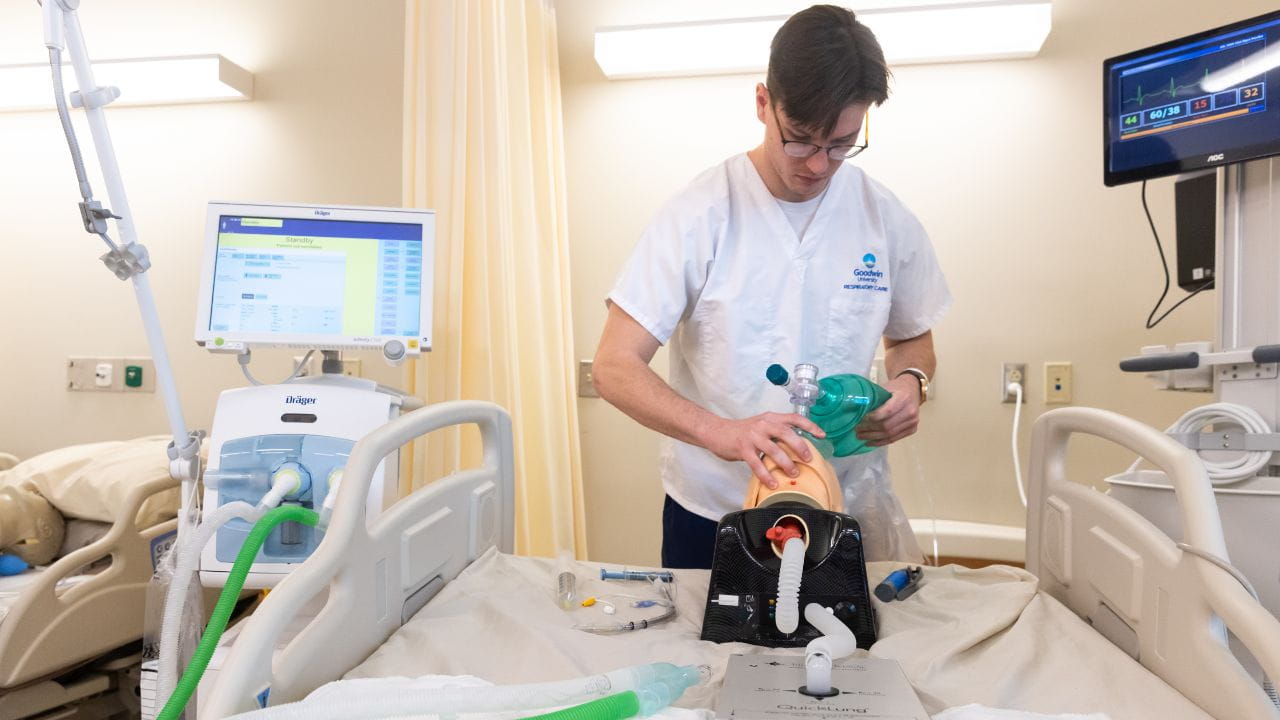
Respiratory therapists specialize in the treatment of patients who struggle to breathe. From premature infants to elderly folks, these professionals help manage a range of cardiopulmonary and respiratory conditions. To many’s surprise, though, this healthcare career can be attained in just a couple of years. The associate degree in Respiratory Care offers in-depth classroom and clinical components, takes just two years to complete, and makes students eligible to become registered respiratory therapists after graduation.
Explore all our healthcare-related majors here!
How to choose the right healthcare college for you
Now comes the big decision: How do you choose the right healthcare college or university? First and foremost, it’s important to assess your professional goals and personal needs. Ask yourself:
- What is my dream career? What’s required to accomplish it, and does the school offer the right program to get me there?
- What is my timeline? How quickly do I want to break into a healthcare career?
- Do I need flexibility through a career-focused healthcare college, or can I commit to a traditional college and medical school experience?
The answers to these questions will help you decide the type of school that’s best for your individual needs at this time.
From there, you can start assessing different healthcare schools. Here are some of the top factors to consider, and key features that the best institutions will offer.
1. They offer a variety of programs.
Healthcare is a multifaceted field, with an array of career choices in research, patient care, administration, and advocacy. Typically, the path you choose to follow will lead you into more specialized training at a dedicated healthcare school. If you are not certain about your desired career path, choose a school that offers an array of program offerings in health.
Goodwin University, for example, offers a variety of healthcare programs: medical assisting, medical billing and coding, respiratory care, public health, dental hygiene, and more. We also offer a general health science program, which can prepare you for a diversity of health occupations if you still can’t decide!
2. They’re flexible to meet your needs.
Convenience and flexibility are key when choosing the right healthcare college. Many students work full or part-time, have family obligations, or generally lead busy lives. It can be difficult to balance all that with a medical program that places strict demands on your time. That is why choosing a flexible program to meet your needs — rather than bending to meet the demands of the program — can be so important.
At Goodwin, we offer day, evening, and weekend classes, as well as hybrid and online course options. And we’re always enrolling! We offer three semesters a year for faster degree starts and completion, plus no wait lists for many healthcare programs.
3. They’re located near you (and near good jobs).
When looking for a healthcare school — particularly if you’ve got a life outside of school — its location can make or break whether you’re in the right place. You should make sure that the school and its clinical settings are located nearby so that you can get to class with no hassle. At Goodwin, we have training facilities right on campus — including a fully functioning dental hygiene clinic!
Additionally, you should make sure that the school is located near reputable healthcare facilities. This can lead to great jobs and internships. Choosing a healthcare college conveniently located near top-rated hospitals, clinics, and offices can open up worlds of opportunity, especially if the school has professional connections with the facilities nearby. With Goodwin’s prime location in East Hartford, we have developed professional relationships with several healthcare leaders in Connecticut, making us a top choice for healthcare education.
4. They offer affordable tuition and/or financial aid.
The best healthcare colleges are not necessarily the most expensive ones. You should find a school that meets your financial needs while providing a top-quality program. They should have accessible services to help you navigate the complicated maze of financial aid, grants, and scholarship opportunities. The best healthcare colleges have a dedicated team of advisors who are committed to helping you cover costs.
At Goodwin, we believe that college is essential and should therefore be accessible and affordable. That is why we offer one of the lowest tuition rates among private, nonprofit colleges in Connecticut. During the admissions process at Goodwin, you will have the opportunity to meet with one of our financial aid advisors to design a personalized financial aid package that meets your needs. We’ll even help you fill out your FAFSA and find scholarship opportunities.
If your healthcare school meets these standards, you’ll know you’re in the right place!
As a leading healthcare university in Connecticut, Goodwin can help guide you through the decision-making process and set you up for success in the healthcare field. The types of programs a college offers, the quality of those programs, class flexibility, and financial aid all can factor into where you choose to go to school.
To learn about earning your healthcare degree at Goodwin University, please call 800-889-3282 today. Or, visit us online to request information easily!
Goodwin University is a nonprofit institution of higher education and is accredited by the New England Commission of Higher Education (NECHE), formerly known as the New England Association of Schools and Colleges (NEASC). Goodwin University was founded in 1999, with the goal of serving a diverse student population with career-focused degree programs that lead to strong employment outcomes.