
History is more than the past. Framing the present and forging the future, the narratives of generations gone by provide not only a window into humanity’s oft-forgotten stories, but also a reflection of who we are today.
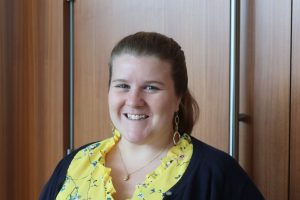
Take, for instance, a moment in time: When Dr. Sarah Seiselmyer-Snyder was only in fifth grade, the trajectory of her career was set into motion. “A Holocaust survivor came and shared a presentation with our class,” she reflects. “I knew about the Holocaust, but hearing the testimony of a survivor first-hand led me to connect with the subject more deeply.”
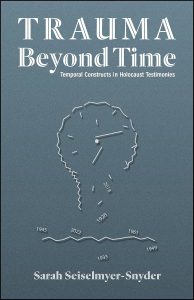
As an adjunct professor of humanities at Goodwin University, Sarah teaches topics ranging from world cultures to the Bosnian Genocide, bringing a survivor-focused perspective on the humanities to her students. In her first book, Trauma Beyond Time: Temporal Constructs in Holocaust Testimonies, she examines the Holocaust through the lens of generational trauma — reminding audiences that pain from the past can still be felt today.
“What happened then is still felt now”

Throughout her schooling, Sarah was an avid reader of Holocaust history, testimonies, and narratives — both fiction and nonfiction — before eventually traveling to Poland and Germany during her senior year of college. While that visit proved deeply impactful, it was during her master’s studies that the idea for her book truly began to take shape, when she undertook intensive research and fieldwork at the Auschwitz-Birkenau Memorial and Museum.
Located in Oświęcim, Poland, Auschwitz-Birkenau once operated as the largest extermination center of the Holocaust. It now serves as a museum and memorial honoring the over 1.5 million lives lost. Here, Sarah lent her efforts to essential conservation and preservation efforts while continuing her research. The experience was, at times, overwhelming. “Mentally and physically, it was very challenging,” she recalls. “As researchers, we were housed at the camp in old offices. It was isolating work.”

In 2015, Sarah returned to Auschwitz-Birkenau Memorial and Museum as a volunteer for an event honoring the 70th anniversary of the camp’s liberation — an event for which survivors and their families were invited to return.
For some survivors, this presented an emotional obstacle. “Many of those who traveled to the event were surprised to find they would be staying in camp,” Sarah explains. “Some survivors were proud to return and felt like they were reclaiming their stories. But for others, it was really retraumatizing. Many of them left.”
Cognizant of these distinct reactions to the survivors’ return, Sarah began grappling with critical questions: “As scholars, how do we interact with survivors who have faced traumatic experiences? How do we perceive trauma?”
These queries sparked the dissertation that would evolve into Trauma Beyond Time. “I wanted to challenge the narratives around trauma and genocide — particularly, the notion that these experiences have a definitive end-date for survivors,” she outlines. “What happened then is still felt now. It just trickles down.”
About Trauma Beyond Time
Informing Sarah’s hypothesis was the concept of generational trauma, a psychological and physiological experience wherein trauma responses cause behaviors, sentiments, and anxieties to be passed down amongst families and communities. “Working with family members of survivors and victims, I saw that the trauma of the Holocaust extended beyond the generations most immediately affected by it,” she explains. “Younger relatives of survivors would often cite the Holocaust itself as the chief source of their trauma —not their parents or older relatives. So, how can we recognize these experiences and help people navigate them?”
Trauma Beyond Time explores this question anecdotally, with the central case study of the book focusing on one family’s story: The Tabaks. “I first met Freida Tabak in 2018 when I was presented with an opportunity to interview Holocaust survivors.” Sarah quickly felt a kinship with Freida. “She has such a lively energy and an amazing sense of humor.”
Sarah’s initial conversations with Freida occurred over Skype, and she soon noticed a barrier. “Sometimes, it seemed like her answers were a bit rehearsed, and it was hard to dive deeper at first.” To strengthen their rapport, Sarah began meeting with Freida in person, ultimately inspiring the deeper conversations that serve as the backbone of the book.
Navigating a family narrative
Given that Trauma Beyond Time adopts a multigenerational approach to Holocaust studies, it wouldn’t be enough for Sarah to interview Freida alone. To serve the purpose of the book — and do full justice to the Tabak family’s experiences — Sarah arranged interviews with Freida’s children, who readily agreed to participate. “They were really open and honest,” Sarah recalls.
This was a double-sided coin, however, calling for discretion. “I had to determine the best way to tell an honest story that did the kids justice, too, but without potentially hurting Freida.”
This wasn’t the only challenge to navigate. Touching on survivors’ direct experiences with the Holocaust and its subsequent generational impacts — such as addiction and suicide — was professionally and personally trying. “I definitely had to take breaks from the process,” she notes. “Especially after my own daughter was born.”
Looking ahead, Sarah is eager to see how audiences respond to Trauma Beyond Time. But her eyes are also set to the future. “I want to do more work focusing on global genocide outside of the Holocaust to help share experiences from other cultures and countries.”
In the face of national and global challenges, Trauma Beyond Time shines a compelling light on the importance of showing up with compassion. Sarah hopes this will be a main takeaway for readers. “These experiences still happen,” she emphasizes. “We need to not only position ourselves to understand these global events, but to also understand their long-term impacts. My hope is that by seeing how these events impact generations of families, we can contextualize the reality that trauma doesn’t end ‘in the moment’.”
Begin making your difference in the world today — learn more about earning your degree at Goodwin University!
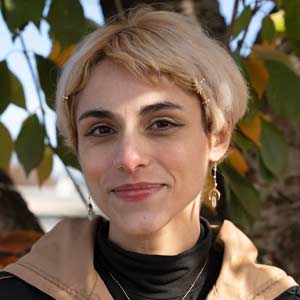
Bri Gagné is a content developer at Goodwin University, bringing backgrounds in literary studies, creative storytelling, Universal Design for Learning (UDL), and social justice. They earned their bachelor’s degree in English Literature, Film Studies, and Gender Studies from University of Connecticut and a master’s in Elementary Education from Eastern Connecticut State University.
After teaching English abroad and locally, Bri transitioned to a full-time writing career, contributing to the University’s educational narratives and brand-building efforts. They are currently earning their Master of Fine Arts in Popular Fiction Writing and Publishing at Emerson College.